
Post Category : Women in Archaeology
Women in Archaeology: Celebrating Zheng Zhenxiang and the Legacy of Fu Hao

By Maegan Huber on February 23, 2026
International Women’s Day is a time to honour the remarkable achievements of women throughout history. Zheng Zhenxiang is a name that should resonate loudly in the annals of archaeology. As a leading female archaeologist from China, her work has not only enriched our understanding of ancient Chinese civilization, but has also shattered stereotypes about women’s roles in scientific exploration.

Image credit: People’s Daily Online, October 2008. All rights reserved.
Biography and Notable Achievements
Born in 1929 in Hebei Province, Zheng was raised in an intellectual family that valued education for all children. Her academic journey began at Tianjin No. 1 Normal College (later restructured as the Tianjin Normal University in 1958, following the establishment of the People’s Republic of China), where she graduated in 1950.
She then moved to Peking University, initially enrolling in the museum department. In 1952, a university-wide restructuring merged her department with the history department, prompting her to transfer to the newly formed archaeology major. She was the only female student in her department during that year. She earned a master’s degree in 1959, and joined the Institute of Archaeology at the Chinese Academy of Sciences (now the Chinese Academy of Social Sciences).
One of Zheng Zhenxiang’s most monumental achievements was the unearthing of Tomb of Fu Hao. Located at Yin Xu, the last capital of the Shang Dynasty (c. 1600-1046 BC), situated near modern-day Anyang in Henan Province, China. This finding in 1976 was nothing short of revolutionary!

Image Credit: The Paper. Zheng Zhenxiang (centre) and Tang Jegen at an excavation site, 1990.
The Tomb of Fu Hao
Before Zheng Zhenxiang and her team, Fu Hao was known primarily from oracle bone inscriptions as a consort of King Wu Ding, a powerful Shang ruler. These inscriptions hinted at her unusual influence, describing her as a military general and high priestess. However, the true extent of her power and prestige remained largely speculative until her tomb was uncovered.
The excavation of the Tomb of Fu Hao was a testament to Zheng Zhenxiang’s leadership and archaeological skill. Unlike many Shang royal tombs, which had been extensively looted over millennia, Fu Hao’s tomb remained intact until it’s excavation. The materials unearthed were breathtaking: including over 1,928 artifacts, including ritual bronze vessels, jade carvings, oracle bones, stone sculptures, and over 7,000 cowrie shells (Shang dynasty currency).
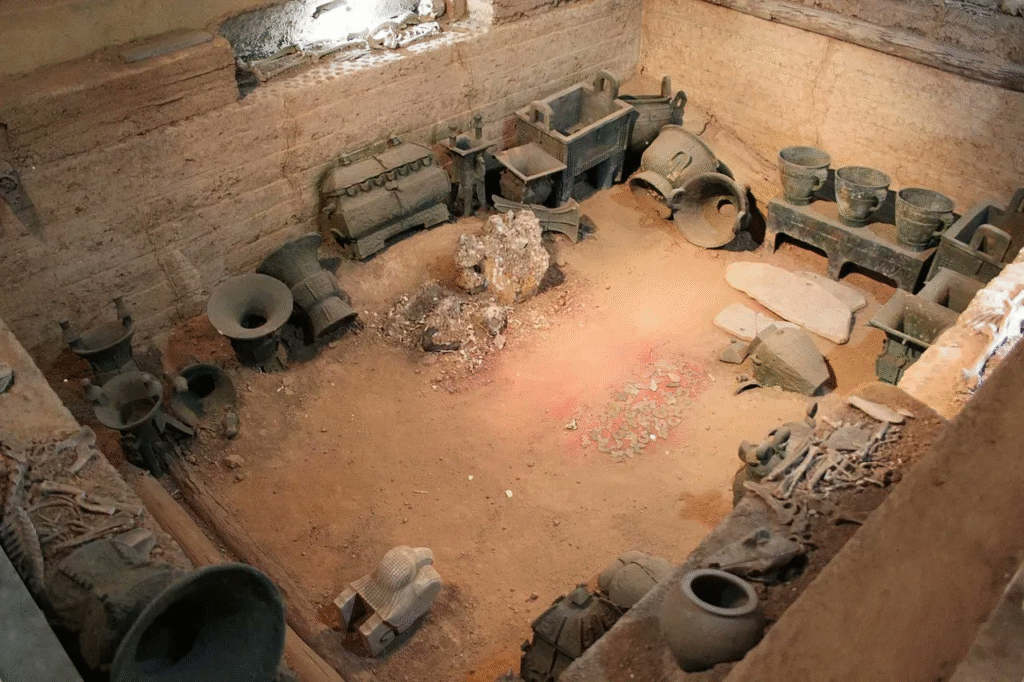
Image credit: Gary Todd, CC0 1.0, Reconstruction of the Tomb of Fu Hao (Tomb 5 at Xiaotun), late Shang dynasty, 1200 B.C.E. Yinxu, Anyang, Henan, China
Zheng Zhenxiang’s Contributions
What made this find particularly extraordinary was the sheer volume and quality of the bronze artifacts, many inscribed with Fu Hao’s name. These weren’t just decorative pieces; they were weapons, tools, and ritual vessels that spoke volumes about her status as a military leader, and her significant role in religious ceremonies. The tomb also contained the remains of 16 human sacrifices and 6 canine skeletons, customary for high-ranking individuals of the time. Over 130 weapons, including four bronze yue axes, associated with the conferment of military authority, were also found in the tomb. Further proof of Fu Hao’s importance as a military commander.
Zheng Zhenxiang’s careful excavation and analysis of these artifacts provided irrefutable evidence of Fu Hao’s immense power and influence. It revealed a society where a woman could not only command armies and lead religious rites, but could also accumulate a vast personal fortune, and could be buried with grandeur. This finding fundamentally reshaped our understanding of women’s roles in the Shang Dynasty, demonstrating that they could hold positions of significant authority and respect.
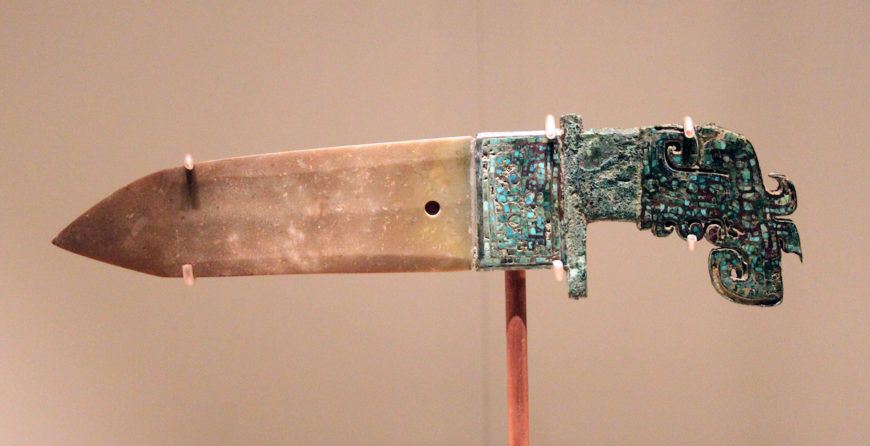
Image credit: Gary Todd, CC0 1., Jade ge dagger, Kneeling figure, jade pei, from the Tomb of Fu Hao (Tomb 5 at Xiaotun), late Shang dynasty, 1200 B.C.E., Yinxu, Anyang, Henan, China.
Zheng Zhenxiang’s Influence
After the fame of the 1976 excavation, Zheng spent over four decades working at the Anyang Archaeological Station, eventually becoming the deputy head of the Anyang Archaeological Team.
Zheng Zhenxiang’s work on the Tomb of Fu Hao stands as an inspiring example of a woman excelling in a traditionally male dominated field. Her dedication to scientific rigor, and her ability to bring complex historical narratives to life through archaeological evidence have paved the way for future generations of female scholars.
Her work following the Fu Hao excavation was focused on several key areas:
- Establishing Chronologies: Zheng played a pivotal role in creating the four-period dating framework for the Yin Xu culture. This framework remains the standard for dating Shang Dynasty sites today.
- Palatial Excavations: Throughout the 1980s, she continued to excavate palace foundations and workshops in the Xiaotun area, deepening the world’s understanding of Shang urban planning.
- Scientific Publishing: She authored and co-authored seminal texts, including Yinxu Fuhao Mu (The Tomb of Fuhao at Yinxu) and Yinxu de Faxian yu Yanjiu (Discoveries and Research at Yinxu), both of which won prestigious scientific achievement awards in the 1990s.
- Mentorship: After retiring from active fieldwork in 2003 at the age of 73, Zheng remained in Beijing, where she spent her final decades writing and mentoring the next generation of archaeologists.
Legacy
Zheng Zhenxiang passed away on March 14, 2024, at the age of 94, leaving behind a legacy that earned her the unofficial title of the “First Lady of Chinese Archaeology.”
On this International Women’s Day, let us celebrate Zheng Zhenxiang not only for her incredible contributions to archaeology and our understanding of ancient China but also as a beacon of female empowerment. Her legacy reminds us that women have always been, and continue to be, at the forefront of discovery, pushing the boundaries of knowledge and unearthing the stories that shape our collective human history.
Maegan Huber
Permit Archaeologist
Related Posts

By Megan Williams
March 8, 2023
Elsie Jury
International Women’s Day In celebration of another International Women’s Day, Ember Archaeology would like to share the life and accomplishments of another impressive archaeologist, Elsie McLeod Murray Jury. Known for being a trowel blazer in the understanding of historical archaeology in Ontario, Elsie Jury worked at many archaeological sites across the province and helped to
Keep Reading
By Alyssa Hamza

March 8, 2022
Mary Vaux Walcott
To celebrate International Women’s Day (March 8th, 2022), I want to share the accomplishments of Mary Vaux Walcott (1860 – 1940). Early Life Mary Vaux was born into a prominent Quaker family in Philadelphia on July 31, 1860. She was the eldest of the Vaux’s three children. The Quakers valued the devotion to God, modesty
Keep Reading
By Madeline Coleman
March 8, 2021
Cecily Margaret Guido (Peggy Piggott)
Books and movies, like The Dig (author John Preston and director Simon Stone), reintroduce us to people in our archaeological history that have either been forgotten or downplayed by societal norms of the time. They encourage us to dig into the past to discover who these people were, and how they contributed to the advancement
Keep Reading