
Post Category : Archaeonerdism Archaeotourism
Field School in Belize – Trent University

By Corey Cookson on December 18, 2017
One of the most common questions that I get asked is what is the coolest thing I have ever found. My default answer is this censer fragment that my excavation team unearthed back in 2009 as part of the Trent University field school in Belize, at the Minanha site.
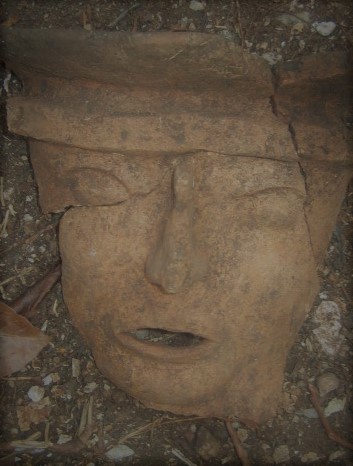
My team was working on the excavation of a house platform. The house platform was part of a small complex of households near a ceremonial and political centre. the site was abandoned around 1000 years ago at the end of the Classic era of the Maya civilization.
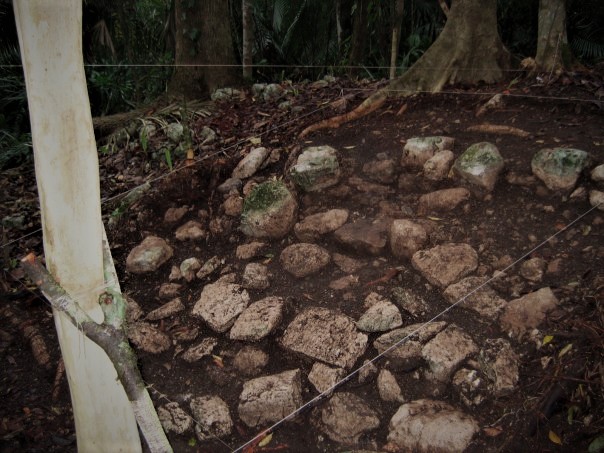
One of the first things found during the excavation was a small cylinder seal next to the large tree root (pictured above). Unfortunately, I didn’t get a picture of the artifact but I still have my notes from the field school and a quick sketch that I did.

As we continued to excavate through different occupation layers, we came upon an assemblage of broken pottery sherds. We were careful to map each artifact before we removed them from their context (as indicated by the nails at each corner of the artifacts). We could see there were holes in the ceramics but had no idea of what was waiting once we turned it over.

When the sherd with the holes was turned over, the entire team got really excited and gathered around while the professor, Gyles Iannone, explained what we found. The artifact was part of a large incense burner. When incense was burned within the vessel, the smoke would come out the holes in the censer. The smoke flowing out of the mouth likely created a very stunning effect. After the field school was completed, the graduate students catalogued the artifacts and re-assembled the censer (pictured below).

Related Posts

By Hailey Kennedy

August 6, 2026
The Archaeology of Kintsugi
What is Kintsugi? Kintsugi (gold joinery), is a term often used to refer to the Japanese method of mending objects by combining lacquer or adhesive with liquid gold or other precious metals. Today, the practice is most commonly associated with ceramics as it often transforms cracked or broken vessels into works of art. Kintsugi often
Keep Reading
By Fallon Hardie

January 28, 2026
Archaeology in Pop Culture
Anyone whose a bit of a movie buff is well-aware of the strong archaeological influence in the Action-Adventure genre. Formative classics like Indiana Jones, The Mummy, and Tomb Raider, for instance, all feature heavy archaeological influences — but not exactly positive ones. Sure, everyone’s beloved Indy battles Nazi’s, Lara Croft is a strong female icon,
Keep Reading
By Corey Cookson
October 17, 2023
International Archaeology Day
What is it? International Archaeology Day is a celebration of Archaeology and it’s contributions to society! International Archaeology Day annually falls on the third Saturday of October (October 21st), and was first celebrated in 2011. The day was originally designed on a national level to help promote public participation and awareness of the important contributions
Keep Reading