
Post Category : Archaeonerdism Archaeotourism Method & Theory
The Archaeology of Kintsugi
Kintsugi (gold joinery), is a term often used to refer to the Japanese method of mending objects by combining lacquer or adhesive with liquid gold or other precious metals. The use of traditional kintsugi techniques to mend artifacts creates a connection to the past, drawing on thousands of years of traditions to facilitate public learning and widespread engagement about the lived experiences of past and present peoples.

By Hailey Kennedy on August 6, 2026
What is Kintsugi?
Kintsugi (gold joinery), is a term often used to refer to the Japanese method of mending objects by combining lacquer or adhesive with liquid gold or other precious metals. Today, the practice is most commonly associated with ceramics as it often transforms cracked or broken vessels into works of art.
Kintsugi often gets used as an umbrella term to refer to all mending processes, but there are many different techniques, reasons, and ways in which objects were mended. In Japan, mending objects goes back thousands of years, though its use on ceramics is much more recent and thought to have become more commonplace during the Momoyama and Edo periods (1573-1868) (Shinoda 2022).
Some mending processes leave no trace of damage whereas others are only used for particular items. For instance yakitsugi is a method that uses an adhesive called shiratama (white ball). However, this technique is reserved for everyday dishware and would not be typical for mending fine chinaware. Rather, kintsugi would be used as a way to enhance an object’s appearance, and to express certain visual characteristics.

The Emergence of Kintsugi
Traditionally, tsugi (join or patch) and tsukuroi (repair) were used within historical contexts to refer to the general mending process, whereas various terms such as kinzukuroi, kinpun tsukuroi, and maki-e tsukuroi specifically recognize the use of gold and are considered to be more synonymatic and interchangeable with kintsugi (Shinoda 2022).
Up until the late 1700s, most mending practices required a natural adhesive-like lacquer called urushi, derived from the tree sap of a urushi tree. Used as a protective coat as well as a glue, employing urushi requires specialized knowledge and careful handling as it can cause skin irritation similar to the effects of poison ivy. Once urushi is applied to ceramic, the adhesive would be combined or dusted with powdered gold and other precious metals or colourants, a process called maki-e (sprinkled picture).
Depending on the extent of the repair, restorers may have incorporated additional materials when mending an object. Wood or fragments from various other ceramic pieces could then be used to mend large surface areas. In recent years, kintsugi has referred to more than the mending of physical objects, becoming a popular metaphor amongst psychologists to help overcome traumatic experiences, and has been a thematic concept explored within the fine arts (Shinoda 2022).
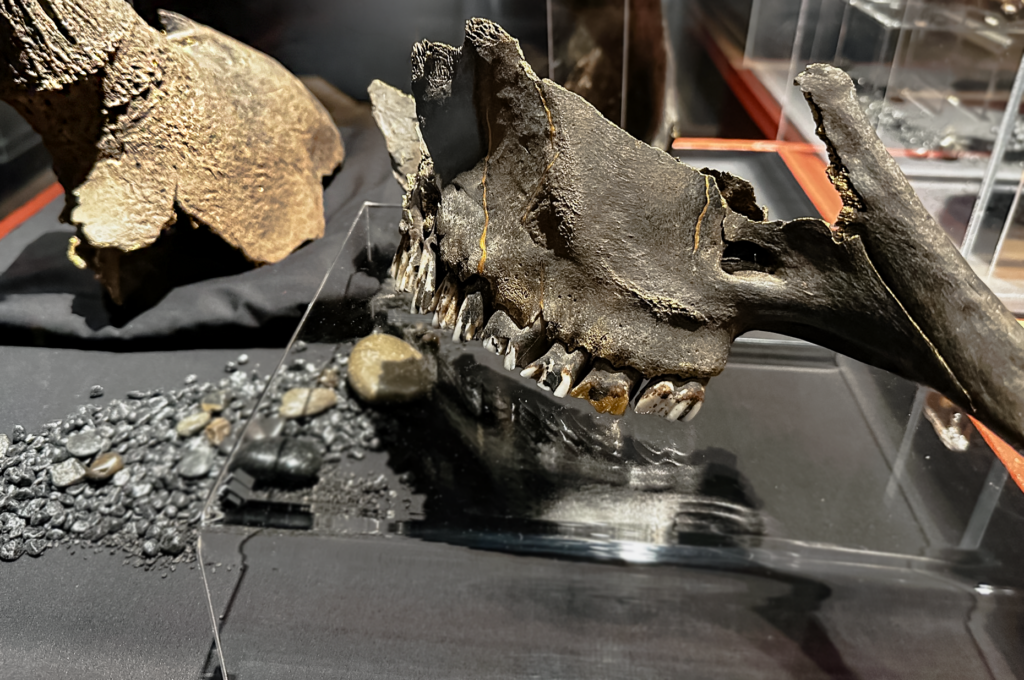
The Beauty of Mending: Kintsugi and Beyond, was an art exhibition hosted at the Art Gallery of Greater Victoria in 2025 and curated by Dr. Heng Wu (Art Gallery of Greater Victoria 2024). The exhibit showcases the work of Naoko Fukumaru, a Japanese artist and conservator who uses Kintsugi as a way to reconnect with her past. The exhibition displayed artifacts from ceramic pieces to stone tools and animal bones, all of which Fukumaru restored with maki-e techniques.

The Archaeological Perspective
Artifacts are objects from past people, often recovered in fragments and examined through archaeological frameworks to understand their purpose and function within people’s lives. In this exhibition, Fukumaru seems to emphasize the renewal of an object through its imperfections and re-frame how artifacts are interpreted. Kintsugi is used as a way to re-integrate meaning towards past objects. The effect seems to create pieces with new meaning, objects belonging to both the past and present.
The use of traditional kintsugi techniques to mend artifacts creates connection to the past for many visitors, drawing on thousands of years of traditions to facilitate public learning and widespread engagement about how these objects were used.
Many artifacts once removed from their context, end up in large storage areas far from public eyes and certain items are intentionally reconstructed to ensure the mended areas remain invisible. However, Fukumaru uses kintsugi as a method to repair and conserve physical artifacts while emphasizing the life history and change an object has undergone throughout its life. This perspective highlights the reconstructive nature inherent within archaeological interpretation and incorporates the fragmented and often complicated journey of many artifacts and objects of the past.
Integrating a culture’s traditional mending practices, like Fukumaru’s use of kintsugi, is a practical conservation technique and highlights missing information of an object while incorporating artifacts back into cultural awareness. This presents a unique opportunity for artifact interpretation more broadly. Viewers interact with these artifacts in a different way and are able to connect with objects as both an artifact and a present-day work of art.
Incorporating new perspectives which reframes artifacts can help to generate and renew public interest in archaeology, providing a sense of connection between lost histories and present day descendants. This opens many intriguing possibilities for the future of artifact conservation, and introduces different ways of inciting public interest about the past. Incorporating fine art and other interdisciplinary perspectives can often foster a deeper understanding of objects, and helps to revitalize cultural relevance once again.
References
Art Gallery of Greater Victoria. 2024. Beauty of Mending: Kintsugi and Beyond. https://aggv.ca/exhibits/beauty-of-mending/
Shinoda, Yayoi. 2022. Mended Bodies: Ceramics Restored with Lacquer. Ars Orientalis vol. 52 244-258.

Hailey Kennedy
Jr. Permit Archaeologist
Related Posts

By Fallon Hardie

January 28, 2026
Archaeology in Pop Culture
Anyone whose a bit of a movie buff is well-aware of the strong archaeological influence in the Action-Adventure genre. Formative classics like Indiana Jones, The Mummy, and Tomb Raider, for instance, all feature heavy archaeological influences — but not exactly positive ones. Sure, everyone’s beloved Indy battles Nazi’s, Lara Croft is a strong female icon,
Keep Reading
By Fallon Hardie

February 12, 2025
Culturally Modified Trees of the Interior, British Columbia
A Foreword For the Archaeologists who’ve found themselves interested in the niches of Ecology and Landscape-Use-Dynamics, we tend to recognize the landscape as a dynamic whole; a manuscript of activities, knowledge, and ideologies that human societies have crafted and applied to the environments in which they live. However, Professional Consulting Archaeologists in Cultural Resource Management
Keep Reading
By Corey Cookson

October 17, 2023
International Archaeology Day
What is it? International Archaeology Day is a celebration of Archaeology and it’s contributions to society! International Archaeology Day annually falls on the third Saturday of October (October 21st), and was first celebrated in 2011. The day was originally designed on a national level to help promote public participation and awareness of the important contributions
Keep Reading